
Setting up a company in Bahrain is straightforward. Getting it bank-ready is where most investors need help.
Saudi Arabia issued 14,300+ MISA licenses in 2024, a 67% jump from the year before. Foreign investors can now own 100% of their business, open a corporate bank account, and obtain residency through one integrated process. This page tells you exactly how.
67% MISA License Rise | 44% FDI Growth Q1 2025 | 95% Online Process | 3–4 Months Timeline
WhatsApp: +973 1311 8811 | Email: info@companyformationinsaudiarabia.com
Why Foreign Investors are Choosing Saudi Arabia in 2026
Saudi Arabia is not an emerging market anymore. It is a functioning, high-growth economy with cleaner foreign ownership rules than many Western jurisdictions. Here is what changed that actually matters:
Geography That Works Practically
Riyadh is a 3-hour flight from Dubai, Mumbai, Nairobi, and Istanbul. For companies serving multiple regions, this is useful not just a talking point.
100% Foreign Ownership
Most sectors no longer require a Saudi partner or local sponsor. You own the business outright. Services, industrial, and agricultural activities qualify without conditions. Trading licenses require four international branches and SAR 10 million capital, a separate consideration.
No Personal Income Tax
Corporate tax applies at 20% for foreign-owned entities. There is no personal income tax on salary earnings in Saudi Arabia.
Sustained Megaproject Demand
NEOM, Qiddiya, Red Sea Project, and the 2034 FIFA World Cup are generating multi-decade demand in construction, technology, logistics, hospitality, and professional services. The pipeline is visible and contracted, not speculative.
4 Special Economic Zones - Operational April 2026
Saudi Arabia's four SEZs offer 5% corporate tax instead of 20%, 0% withholding tax, and customs exemptions. These became fully operational in April 2026. If your business qualifies, this is worth evaluating before you commit to a mainland LLC structure.
What you receive at the end of the process
A fully-formed Saudi company is not just a registration number. Here is the complete list of what gets handed to you:
- Trade Licence (Commercial Licence)
- Commercial Registration (CR)
- Memorandum of Association
- Corporate Bank Account
- Residency (Iqama) for the investor
- Tax Certificate (ZATCA registration)
- GOSI Registration (Social Insurance)
- Ministry of Labour Registration
What you receive at the end of the process
A fully-formed Saudi company is not just a registration number. Here is the complete list of what gets handed to you:
| Feature | LLC | Foreign Branch | Entrepreneur License |
|---|---|---|---|
| Best for | SMEs, consultancies, general trading | Expanding an existing foreign company | Early-stage startup founders |
| Foreign ownership | Up to 100% | Parent company owns it entirely | 100% |
| Practical capital | SAR 500,000 | Depends on parent company | SAR 2,000/yr (annual fee) |
| Shareholders | 1–50 | N/A — extension of parent | Individual founder |
| Liability | Limited to capital contribution | Parent company is liable | Limited |
Note:
For trading activities, MISA requires four existing international branches and SAR 10 million capital. Services and industrial activities have no such conditions. Not sure which applies to you? Ask us.
How the Process Works, Step by Step
The following steps reflect the official sequence as required by the Ministry of Industry and Commerce. Steps cannot be reordered; each stage produces documentation required by the next.
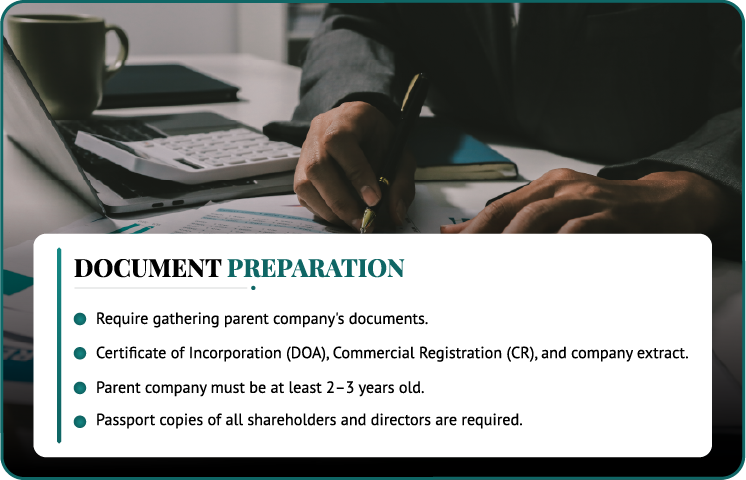
Step 1: Document Preparation
Gather your parent company's documents: Certificate of Incorporation (DOA), Commercial Registration (CR), and company extract. Your parent company must be at least 2–3 years old. Passport copies of all shareholders and directors are also required at this stage.
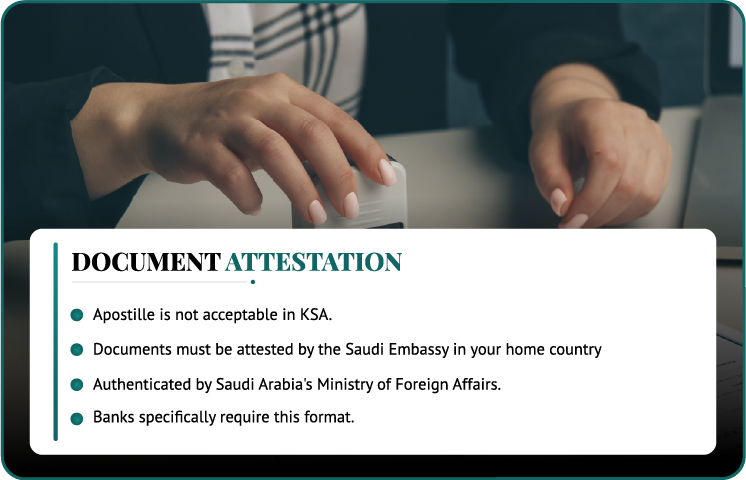
Step 2: Document Attestation
This is the step most investors underestimate. Saudi Arabia does not accept Apostille. Your documents must be attested by the Saudi Embassy in your home country, then authenticated by Saudi Arabia's Ministry of Foreign Affairs. Banks specifically require this format; do not substitute it.
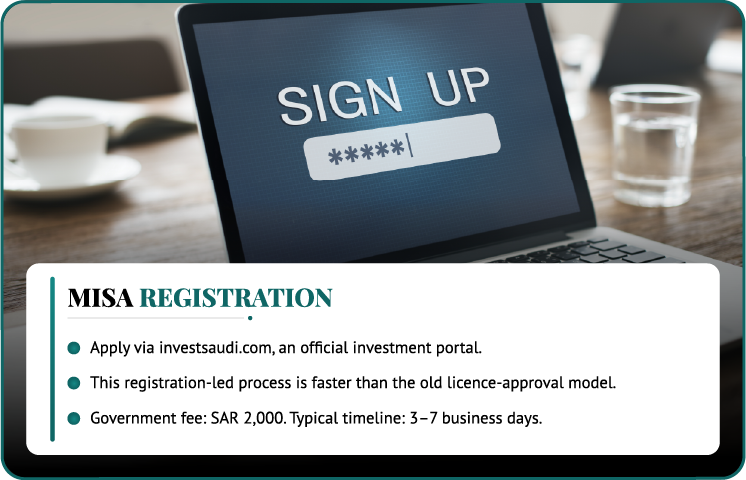
Step 3: MISA Registration
Apply via investsaudi.com, Saudi Arabia's official investment portal. Under the Investment Law effective February 2025, this is now a registration-led process — faster than the old licence-approval model. Government fee: SAR 2,000. Typical timeline: 3–7 business days.
Step 4: Name Reservation
Reserve your company name through the Ministry of Commerce online portal. The name must reflect your business activity and must not conflict with existing registrations. Timeline: 1–2 business days.
Step 5: Articles of Association
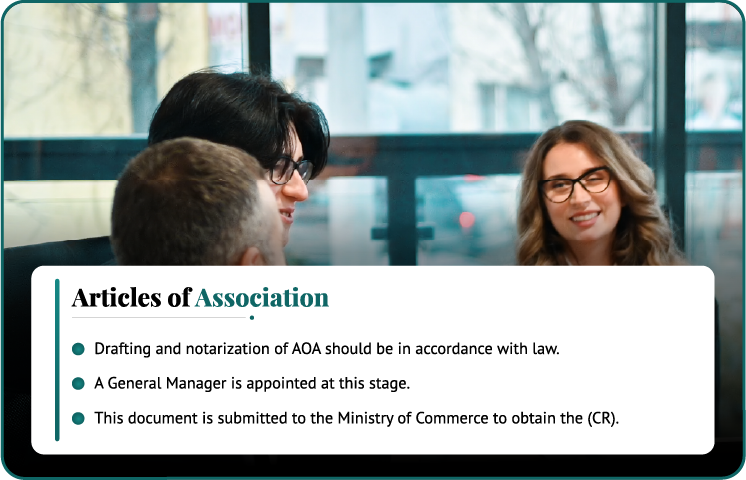
Draft and notarise the Articles of Association in line with Saudi company law. A General Manager is appointed at this stage. This document is submitted to the Ministry of Commerce to obtain the Commercial Registration (CR).
Step 6: Visit 1 - Memorandum Signing (1 day)
The final step of company registration requires a physical signature on the Memorandum of Association in Saudi Arabia. This can be completed via a notarised Power of Attorney (POA) if you cannot travel, making it feasible for busy investors based outside the region.
Step 7: Company Documents Issued
Your Trade Licence, CR, GOSI registration, and Ministry of Labour registration are issued. The company is now legally operational in Saudi Arabia.
Steap 8: Visit 2 - Residency and Banking (7-10 days)
Return to Saudi Arabia approximately one month after company formation to complete your Iqama and open the corporate bank account. The schedule below applies:
| Day | Activity |
|---|---|
| Day 1 | Biometrics — fingerprints and photo |
| Day 3–4 | Medical Examination |
| Day 7–8 | Iqama (Residency ID) Issuance |
| Day 8–9 | Corporate Bank Account Opening |
Total end-to-end timeline: 3-4 months
What it costs in SAR, upfront
We quote in Saudi Riyals, so there are no currency surprises. The figures below are what you pay.
| Service | Fee (SAR) |
|---|---|
| Company Formation | SAR 45,000 |
| Residency (Iqama) | SAR 20,000 per year |
| Monthly Maintenance | SAR 2,500 / month |
| Corporate Bank Account | SAR 10,000 |
Annual renewal costs (government fees, client-borne):
| Item | Annual Cost |
|---|---|
| Company (CR) Renewal | SAR 60,000 + SAR 3,500 |
| Residency (Iqama) Renewal | SAR 15,000 (online) |
Local Agent Fee: A Saudi or Bahraini agent is required as part of the process, billed at SAR 1,000–2,000 per year. This is disclosed upfront.
Tax overview for foreign-owned companies
Corporate Income Tax
20% Applies to net profits of foreign-owned entities on the Saudi mainland. Saudi nationals and GCC company owners pay Zakat instead, which operates under a different calculation.
VAT
15% Mandatory registration with ZATCA (Zakat, Tax and Customs Authority) applies once annual taxable sales exceed SAR 375,000 (approximately USD 100,000). Filed through ZATCA’s portal.
Special Economic Zones
5% Corporate Tax The four SEZs operational from April 2026 reduce corporate tax to 5% and eliminate withholding tax. Worth examining if your business activity qualifies before committing to mainland incorporation.
No Personal Income Tax
Salaries paid to employees and shareholders in Saudi Arabia are not subject to personal income tax.
Documents you will need
From your home country (attested via Saudi Embassy + Saudi MFA):
- Certificate of Incorporation / Deed of Association (DOA)
- Commercial Registration from home country
- Company Extract (typically required within the last 3–6 months)
- Passport copies of all shareholders and directors
- Board Resolution authorising the Saudi entity (for branch applications)
Your parent company must be at least 2–3 years old to qualify.
Saudi-side (we prepare these):
- Name Reservation Certificate
- Articles of Association — drafted and notarised locally
- Registered office address (lease agreement)
- Power of Attorney — if you cannot travel for the signing visit
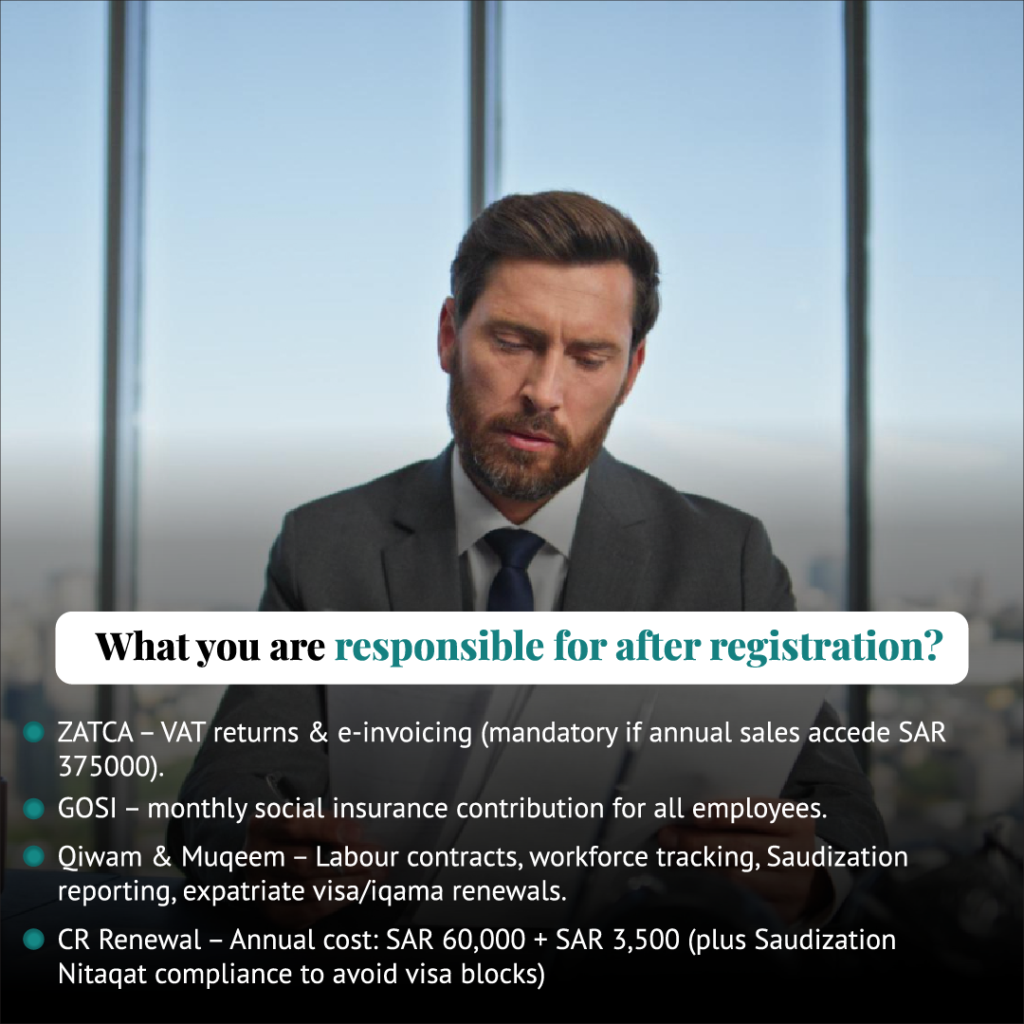
What you are responsible for after registration
Company formation is the beginning. Saudi Arabia has structured annual compliance requirements. Missing any of these affects your ability to issue visas, employ staff, and renew licenses.
- ZATCA — VAT returns and e-invoicing compliance (mandatory if annual sales exceed SAR 375,000)
- GOSI — Monthly social insurance contributions for all employees
- Qiwa Portal — Labour contracts, workforce tracking, and Saudization reporting
- Muqeem — Expatriate visa issuance and Iqama renewals
- Wage Protection System (WPS) — Mandatory payroll compliance
- CR Renewal — Annual: SAR 60,000 + SAR 3,500
- Saudization (Nitaqat) — Minimum Saudi employee quotas based on company size and sector. Non-compliance blocks new visa issuance.
Our Monthly Maintenance package at SAR 2,500/month covers ongoing oversight of these obligations.
Where foreign investment is going in 2026
MISA data and market activity point to consistent inflows in these sectors:
Services, industrial, and agricultural investments qualify for full foreign ownership without the additional conditions that apply to trading licences.
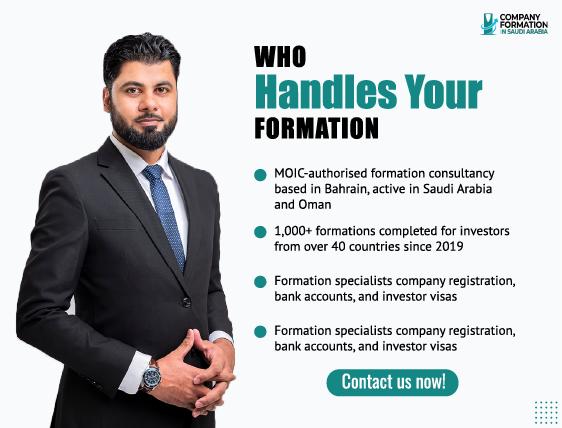
Who Handles your Formation
PI Startup Advisory Co. is a MOIC-authorised business advisory and company formation consultancy based in Bahrain, with active formation operations in Saudi Arabia and Oman. Founded in 2019, we have completed 1,000+ formations across the GCC for international investors from over 40 countries.
We are not a law firm. We are formation specialists — focused on getting companies registered, bank accounts opened, and investors operational.
Saqlain Akram — Managing Director M.Com | CAML | Oman Accredited Certified Public Accountant (OACPA)
📍 Building 435-G, Road 1805, Block 318, Hoora, Manama, Bahrain
📞 +973 1311 8811
🌐 pistartup.co
Questions We Get Asked Most
Below are some frequently asked questions that are commonly asked:
Can foreigners own 100% of a company in Saudi Arabia?
Yes, in most sectors. Services, industrial, and agricultural investments qualify without conditions. Trading licenses require four existing international branches and SAR 10 million capital. If you are unsure which category applies to your activity, ask us before proceeding.
Do I need to travel to Saudi Arabia?
Two visits are required. The first (1 day) can be done via Power of Attorney. The second (7–10 days) is for residency and bank account opening and requires your physical presence.
How long does the full process take?
3–4 months from document preparation through to a fully operational company with residency and bank account.
What is a MISA registration and do I need one?
MISA (Ministry of Investment of Saudi Arabia) is the regulatory authority for foreign investment. Foreign investors must register with MISA before commencing business activities. The government fee is SAR 2,000 and the process takes 3–7 business days under the updated February 2025 framework.
Can I use an Apostille on my documents?
No. Saudi Arabia does not accept Apostille for company formation purposes. Documents must be attested through the Saudi Embassy in your home country, then authenticated by Saudi Arabia’s Ministry of Foreign Affairs. Banks specifically require this chain of attestation.
What is the corporate tax rate?
20% for foreign-owned mainland entities. 5% in the four Special Economic Zones (operational from April 2026).
What is Saudization and how does it affect me?
The Nitaqat programme requires companies to employ a minimum percentage of Saudi national employees, calculated by company size and sector. Failing to meet your Saudization quota blocks new work visa issuance. New companies should plan their workforce structure from day one.
What does your SAR 45,000 formation fee cover?
End-to-end management: MISA registration, name reservation, Articles of Association preparation, Ministry of Commerce liaison, and delivery of all company documents including Trade Licence, CR, Memorandum of Association, GOSI, and Ministry of Labour registration. Bank account and residency are priced separately.
Ready to register your company in Saudi Arabia?
We manage the entire process document attestation through to Iqama and bank account. Fixed fees, clear timelines, no surprises.
WhatsApp: +973 1311 8811 | Email: info@companyformationinsaudiarabia.com